
Spain rewards travellers who understand one basic thing before opening a booking app: this is not one transport problem.
Madrid to Barcelona is one problem. Seville to Granada is another. Bilbao to a village in Asturias is another. Mallorca, Tenerife and La Gomera are different again.
Treat them all the same and you can spend an impressive amount of money proving that a rental car is inconvenient in Madrid, a train cannot drive to a rural finca and an island is, inconveniently, surrounded by water.
The useful question is not “What is the best way to travel around Spain?”
It is “What is the best way to travel around this part of Spain?”
The direct answer
For most first-time trips:
- Use high-speed rail between major mainland cities where the network is strong.
- Use conventional rail or coaches where they fit the route better than flying or driving.
- Rent a car when the destination itself is rural, dispersed or poorly connected by public transport.
- Fly when the geography makes rail unrealistic, especially for the Canary Islands and some longer mainland–island combinations.
- Use ferries when island-hopping, travelling with a vehicle, or when the sea route is part of the journey rather than a punishment for not checking the timetable.
Spain’s official tourism portal describes an extensive high-speed rail network, a large fast-road network, domestic air links and ferry connections between islands. That sounds wonderfully simple. The detail is where holidays either become elegant or turn into luggage management.
TRAINS: THE DEFAULT FOR MANY MAJOR CITY ROUTES

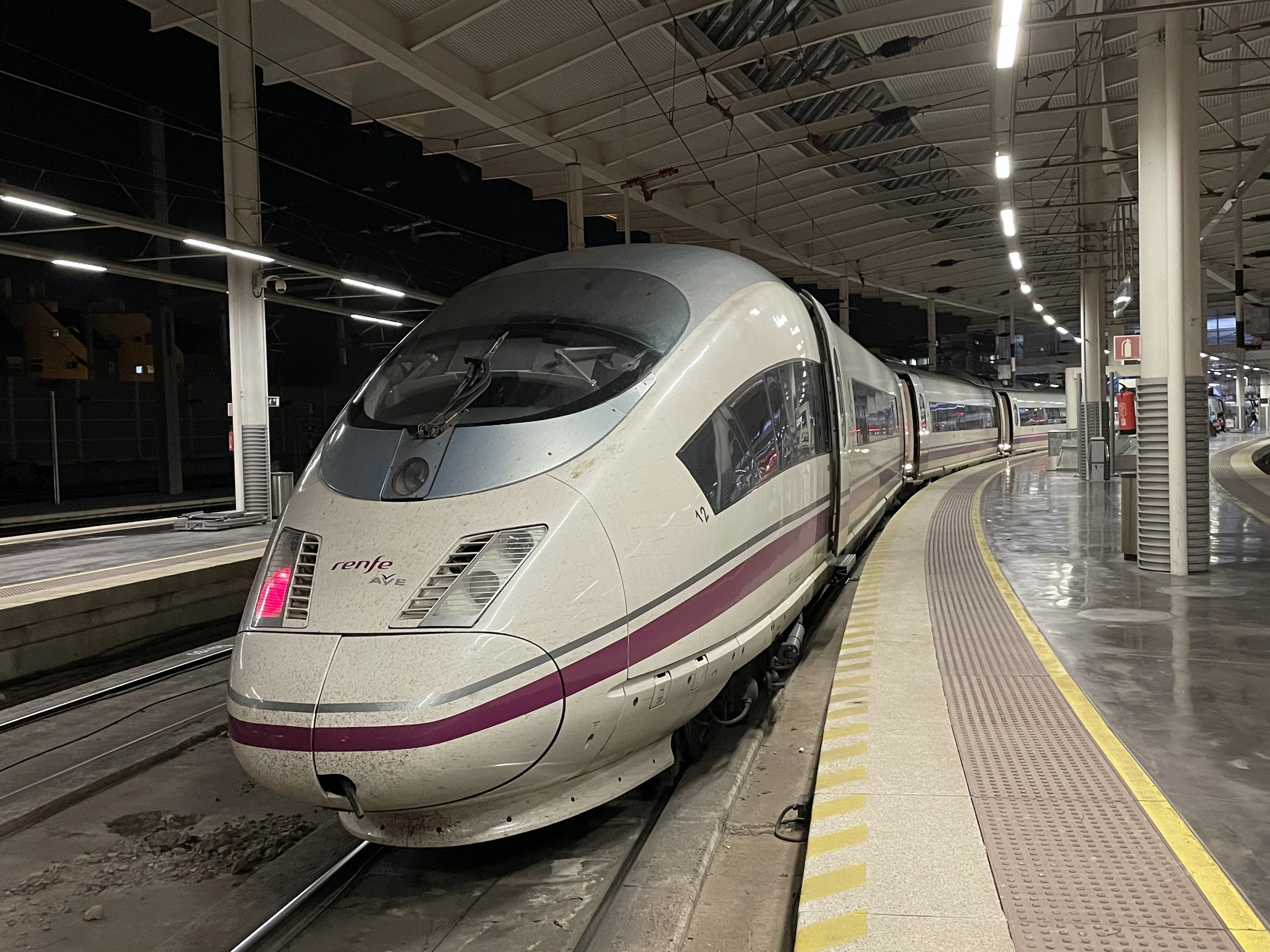
For Madrid, Barcelona, Valencia, Seville, Málaga, Zaragoza and several other large mainland destinations, rail should be one of the first options you compare.
Spain.info highlights high-speed connections linking Madrid with major cities such as Barcelona, Seville and Valencia. Renfe operates much of the national passenger rail network, while other operators also serve selected high-speed corridors.
The important evergreen point is not a particular departure time or fare. Those change.
The important point is that Spain’s major-city rail corridors can remove two things travellers routinely underestimate: airport friction and city-centre driving.
Why trains often win door to door
A short flight looks fast when the comparison begins at take-off and ends at landing.
Real travel begins earlier.
Airport transfer. Check-in. Security. Boarding. Waiting. Baggage. Arrival transfer.
A central rail station can turn a nominally slower train into the easier overall journey, especially when both cities sit comfortably on the high-speed network.
This is why Madrid–Barcelona, Madrid–Valencia and Madrid–Seville are usually routes where rail deserves serious consideration before domestic flying.
When rail is less convincing
Spain’s rail geography is strong but not magical.
Northern coastal journeys, rural routes and some cross-country combinations can be slower or less direct than the map suggests. Bilbao, Santander, Asturias, Galicia and smaller inland destinations may require a different planning mindset from the Madrid-centred high-speed corridors.
Do not assume two places have a convenient rail connection merely because both have stations.
The rail map is a network, not a promise that every pair of dots is friends.
Booking rail sensibly
For actual travel dates:
- check the current operator serving the route;
- compare departure and arrival stations, not only city names;
- confirm luggage/bicycle rules if relevant;
- leave sensible margins around flights or other separate tickets;
- check whether changing trains improves or ruins the journey;
- treat fares and departure times as live information, not evergreen editorial facts.
TripMag will not freeze a 2026 timetable into an article and pretend it is infrastructure.
BUSES AND COACHES: THE PART OF THE NETWORK PEOPLE UNDERESTIMATE
Long-distance and regional coaches matter in Spain because not every useful travel pair sits on a direct rail corridor.
A coach can be the better practical answer for smaller cities, regional routes and places where the rail journey requires an awkward change.
It is also worth checking local and regional bus systems once you leave the major urban centres. Rural Spain often becomes much more understandable when you stop asking what the AVE does and start looking at the actual regional network.
When a coach makes sense
Use it when:
- the rail route is indirect;
- the bus arrives closer to the final destination;
- the journey is regional rather than national;
- the fare difference matters and the time penalty is reasonable;
- a smaller destination has limited rail service.
The glamorous answer is not always the useful answer.
A coach that leaves from the right place and stops where you are actually staying can beat a faster train to a city you did not intend to visit.
DRIVING IN SPAIN: EXCELLENT WHEN THE CAR SOLVES A REAL PROBLEM
A car is valuable in Spain when the geography becomes the attraction.
That includes selected rural routes, mountain areas, dispersed coastal regions, white villages, vineyard/countryside stays and some island itineraries.
A car is less impressive when it spends three days in an underground city-centre garage collecting fees while you walk everywhere.
Where a rental car can add real value
Consider one for:
- rural Andalusia;
- selected pueblos blancos routes;
- countryside stays away from transport hubs;
- parts of northern Spain where the desired route links smaller towns, coast and nature;
- island exploration when beaches, trailheads or villages are dispersed;
- road trips where stopping between destinations is the point.
Where it can become luggage with wheels
Think carefully before renting simply for:
- central Madrid;
- central Barcelona;
- central Seville;
- a route already served cleanly by intercity rail;
- a trip where the car will be parked for most of the stay.
City driving adds parking, restricted-access rules, traffic and navigation to a journey that may already have a perfectly good rail solution.
Licence and document rules
Driving-document requirements depend on where the licence was issued.
Spain’s traffic authority, DGT, states that valid EU/EEA driving licences are accepted in Spain while they remain valid. For licences issued elsewhere, the rules depend on the licence and the traveller’s circumstances, so check DGT before driving. DGT’s guidance for foreign visitors says drivers whose licence is not from the EU/EEA should carry an International Driving Permit together with the relevant national licence and identification; other validity rules and recognised licence formats can also matter.
This is exactly the kind of rule that deserves an official source rather than a forum post written by someone whose cousin rented a Fiat once.
Always check the current DGT guidance for your nationality/licence before driving.
Do not treat city access rules as decoration
Spanish cities can operate restricted-access and low-emission schemes, and local rules can differ.
If accommodation is in a historic centre or controlled zone, ask the property about vehicle access and parking before arrival.
A hotel address is not proof that you may legally drive to its front door.
DOMESTIC FLIGHTS: USEFUL WHEN THE MAP GETS SERIOUS
Spain has a broad airport network. Aena lists airports across the mainland, Balearic Islands and Canary Islands, including major gateways such as Madrid-Barajas, Barcelona-El Prat, Málaga, Palma de Mallorca, Gran Canaria and both Tenerife airports.
Flying becomes much more persuasive when the journey crosses sea or very long mainland distances.
When flying makes sense
Common examples include:
- mainland Spain to the Canary Islands;
- some mainland–Balearic journeys;
- longer north–south or east–west trips where rail is indirect and time is limited;
- open-jaw itineraries where flying into one region and out of another avoids backtracking.
When flying may be unnecessary
For major high-speed rail corridors, compare door-to-door time rather than air time.
Madrid–Barcelona is the classic example: the existence of a flight does not automatically make flying the better transport choice.
Airports belong in itineraries when they solve geography, not because aircraft feel faster in theory.
FERRIES: NOT JUST FOR PEOPLE WHO DISLIKE AIRPORTS

Ferries are an important part of travel in the Balearic and Canary Islands, and some routes also connect mainland ports with island destinations.
Spain.info describes frequent inter-island ferry connections in both archipelagos, with some services allowing vehicles aboard.
For travellers building an island-hopping route, ferries can be more useful than repeatedly returning to an airport — but only when the actual islands and ports connect sensibly.
When a ferry is the right choice
Consider it when:
- neighbouring islands have a practical direct connection;
- you are travelling with a vehicle;
- departure and arrival ports fit the accommodation plan;
- the sea journey itself is acceptable or enjoyable;
- airport transfers would add more friction than the ferry saves.
When a ferry is not automatically better
Some inter-island crossings are short; others are not.
Do not look at two islands on a map and assume they are connected by a quick boat.
Check the current operator, port, duration and seasonal service for the exact travel date.
An island chain is geography, not a metro map.
THE BALEARIC ISLANDS
Mallorca, Menorca, Ibiza and Formentera need their own transport logic.
Flights connect the larger islands with mainland Spain and other destinations, while ferries link islands and mainland ports on selected routes.
A car can be useful on Mallorca, Menorca or Ibiza if the trip depends on dispersed beaches, rural accommodation or interior villages. It is less useful when the plan is concentrated in one walkable urban/resort area.
Formentera is a different case because access is by sea rather than commercial airport.
Plan the island first, then decide whether a car solves the itinerary. Do not rent one simply because islands look like road trips in advertising.
THE CANARY ISLANDS
The Canary Islands sit far from mainland Spain and operate as their own transport ecosystem.
Flying is the normal long-distance gateway from mainland Europe. Within the archipelago, both flights and ferries can connect islands depending on the route.
Tenerife has two major commercial airports, while other islands including Gran Canaria, Lanzarote, Fuerteventura, La Palma, La Gomera and El Hierro have their own airport access within the Aena network.
The correct transport choice depends heavily on which islands are being combined.
A ferry can be excellent between some neighbouring islands. A flight may make more sense for a longer cross-archipelago move.
Do not build a seven-day Canary itinerary by collecting airport codes. Choose one or two islands whose geography justifies the transition.
CITY TRANSPORT
Spain’s larger cities generally combine walking with metro, suburban rail, tram and/or bus networks.
Spain.info notes extensive public-transport networks in major cities and recommends checking local operating hours because late-night patterns differ by city and day.
The editorial rule is simple: use city transport to reduce unnecessary distance, not to avoid understanding the city.
Madrid
The centre is walkable in sections but large enough that Metro and commuter rail can materially improve a day.
Barcelona
Metro, buses and local rail are useful for crossing the city and reaching places beyond the compact central neighbourhoods.
Seville
Much of the visitor core works well on foot. Public transport becomes more useful when accommodation or specific sights sit beyond that core.
Valencia
A mixture of walking, urban public transport and cycling can work depending on where you stay and whether the beach/City of Arts and Sciences are priorities.
The mistake is not using public transport.
The mistake is buying a transport product before understanding whether you will actually need it.
TAXIS AND RIDE-HAILING
Official taxis remain useful for airport transfers, late arrivals, luggage-heavy journeys and situations where local public transport is awkward.
Spain.info advises using authorised taxis and checking payment/surcharge details.
Ride-hailing availability and regulation can vary by city and over time, so TripMag does not treat a particular app as permanent national infrastructure.
Check what is legally operating in the destination when you travel.
ACCESSIBILITY
Transport accessibility should be checked route by route rather than assumed from a national label.
Major stations and airports generally publish accessibility information, while smaller stations, ferries, buses or historic centres may create more friction.
Travellers using wheelchairs, mobility aids or assistance services should verify:
- step-free access;
- boarding assistance;
- accessible toilets;
- platform/vehicle compatibility;
- advance-notice requirements;
- accessible transfer options at the destination.
The most important accessibility detail is often not the main journey. It is the final 800 metres.
HOW TO CHOOSE THE RIGHT MODE
Madrid → Barcelona
First comparison: high-speed rail.
Why: strong city-centre rail logic and an established high-speed corridor.
Madrid → Seville
First comparison: high-speed rail.
Why: established direct major-city corridor.
Barcelona → Valencia
First comparison: rail.
Why: mainland Mediterranean route where rail avoids airport overhead.
Seville → Granada
Compare: rail and coach for your exact date.
Why: both can be relevant depending on schedule and onward plans.
Madrid → Tenerife
First comparison: flight.
Why: the Canary Islands are far offshore; this is not a rail problem waiting to be solved.
Mallorca → Menorca or Ibiza
Compare: ferry and flight where applicable.
Why: port/airport location and the rest of the island itinerary matter as much as scheduled duration.
Bilbao → rural Asturias/Cantabria route
Compare: car with regional public transport.
Why: the value of a car rises when the itinerary itself is dispersed.
COMMON TRANSPORT MISTAKES
1. Renting a car for Madrid and Barcelona because “we like flexibility”
That flexibility often spends the afternoon looking for parking.
2. Flying every long-looking route
High-speed rail can make some apparently large distances surprisingly manageable.
3. Assuming the high-speed network covers every interesting place
It does not. Spain gets more interesting when the transport map becomes less tidy.
4. Treating islands as an extension of the mainland schedule
Every flight or ferry adds a transition. Count it honestly.
5. Trusting an old timetable in a travel blog
Use the operator for the actual travel date.
6. Booking the cheapest transport before accommodation
A bargain arrival at the wrong airport, port or station can become expensive once transfers are added.
7. Choosing a car after choosing a central old-town hotel
Reverse the sequence. Understand access and parking first.
WHO SHOULD TRAVEL SPAIN MOSTLY BY TRAIN?
Travellers building a route around major mainland cities.
Couples, solo travellers and families who want fewer airport procedures can find rail particularly attractive when stations are central and the route is direct.
Luxury travellers may value the same thing for a different reason: good rail can buy time, not merely save money.
WHO SHOULD SERIOUSLY CONSIDER A CAR?
Travellers whose real destination is countryside, coast, mountains, villages or a dispersed island route.
The car should unlock the geography.
If it only moves between cities already linked well by rail, it may be solving a problem that was not there.
TRIPMAG VERDICT
Spain is not difficult to travel around.
It is easy to travel around badly.
Use trains where Spain has built a strong rail corridor. Use cars where the landscape becomes fragmented. Use flights when sea and distance make them sensible. Use ferries when the island geography supports them.
And stop asking one transport mode to prove it is the best everywhere.
The best Spanish transport system is not a train, car, plane or ferry.
It is choosing the correct one before you buy the ticket.
Understanding Spain's main railway stations
In Madrid, Atocha and Chamartín are different transport gateways whose services and onward connections depend on the route. In Barcelona, Sants is a major long-distance station, but your accommodation may be better connected through another local interchange. In Seville, Santa Justa is relevant for many intercity services, yet reaching the old centre still takes additional time. A practical plan begins with the exact station printed on the ticket, not the assumption that a train arrives in the city's most tourist-friendly square.
For travellers moving between two major cities, compare the complete journey: hotel checkout, metro or taxi to the station, security or boarding procedures if applicable, train travel, then the local transfer at arrival. A flight that looks much faster on its advertised schedule may lose much of that advantage to airport time. Conversely, a long rail route crossing much of the country can be less attractive than flying if the destination is genuinely far away and the airport transfer is sensible. It is the door-to-door journey that counts.
Rail tickets: how to avoid an expensive wrong assumption
Rail competition and different service products mean ticket flexibility and baggage conditions cannot be described by a single “Spanish train” rule. Renfe, Iryo and Ouigo operate different services and fare structures on particular routes. Compare official booking details for the exact train, departure station, refund conditions and luggage allowance. A very cheap headline fare may not be the best purchase for someone carrying several bags or arriving on a flight with an uncertain landing time.
Some travellers benefit from fixed-time tickets booked ahead, while others need the ability to change travel. For a journey immediately after an international arrival, an inflexible reservation may be a false economy. If an early train creates an extremely tight connection from the hotel, consider whether a slightly later departure would preserve the day's enjoyment. Never recommend buying a pass without calculating the individual journeys and the pass's actual coverage.
Coaches: useful for cities and rural access
Coaches can reach towns that lack a convenient rail connection and may provide worthwhile alternatives between some major cities. However, terminals are not always located near the visitor's intended neighbourhood, and there can be several services or operators with different stop patterns. Check the departure location and arrival point, as well as the last return bus. For rural towns or historic sites, the last local link may determine whether the trip works without a car.
Long-distance buses can be cost-effective for flexible travellers, though journey time and comfort expectations differ from high-speed rail. If travelling with mobility equipment or bulky luggage, contact the operator to confirm the actual service arrangements rather than relying on a generic route listing. Where a direct coach saves several rail changes, it can offer a calmer experience than an unnecessarily complicated itinerary.
Driving in Andalusia and rural central Spain
A car is valuable when you want villages, landscape stops or small properties beyond frequent public transport. In parts of Andalusia, a planned drive between towns may open places that are awkward by coach, but parking in historic centres can be limited or expensive. Choose accommodation with a clear arrival plan. Some historic districts have narrow streets or restrictions that are poorly suited to a rental vehicle, and a hotel address inside an old quarter does not guarantee you can drive to its door.
If your route involves Seville, Granada and Córdoba but no remote towns, rail and coach travel may be entirely adequate. Hire a car for the rural segment if necessary, not automatically for the entire holiday. Compare tolls, fuel, insurance excess, parking and any restrictions before concluding that a low daily rental price makes driving cheaper.
Driving on islands versus staying in one resort
On Mallorca, a car can help reach different villages and parts of the coast, but a family staying beside an accessible beach may need one only for an occasional outing. Tenerife's road geography, elevation and distance between the wetter north and sunnier southern resort areas can make a rental useful for exploring, though mountain roads demand cautious driving. Gran Canaria's interior is very different from its coastal resorts, and some routes include winding roads not apparent on the map.
On smaller or more rural islands, public transport frequency and the final approach to a trail or cove can vary. Before hiring, check parking at your accommodation and the exact destinations you intend to visit. An island's dimensions alone do not tell you whether it is easy to explore by car in a short day. A relaxed week may benefit from one carefully chosen base and a few targeted excursions rather than daily cross-island driving.
Urban mobility: walking, trams and local passes
Madrid and Barcelona offer extensive public transport, but fare systems, zones and ticket rules vary. In Valencia, the relationship between city, coast and public transport may determine the best neighbourhood for a mixed trip. In Seville and Granada, historic streets and hills make the walking conditions themselves important. Do not assume that a popular metro station is step-free on every entrance or that a route from an old-town hotel will be comfortable with wheeled luggage.
For multi-day city stays, price current local tickets through the transit authority rather than repeating outdated fare tables. If you plan to walk most days, an unlimited pass may not be necessary; if your hotel is farther out, a suitable travel product could be useful. Validate tickets as required and check airport supplements where applicable. Comfortable shoes, shade and a manageable pace remain essential parts of Spanish urban transport.
Regional day trips without a rental vehicle
A day trip from Madrid to Toledo or Segovia requires more than the intercity travel time: identify the arrival station or terminal and how to reach the historic centre. For Córdoba from Seville, the trip may be practical by train, but museum access and local walking still take time. A Granada trip built around the Alhambra should give enough space for timed-entry requirements and the uphill approach. Small detours that look convenient on a map can become stressful if the last return connection is early.
Choose one important outing per day. Check weekday versus weekend departures and any seasonal changes. In northern Spain, a village or coastal destination may have limited bus service; a guided local excursion can be an option if it matches your interests, but should not be presented as the only way to travel. The general principle is to make the transport serve one strong experience, not to collect three towns and spend most of the day in transit.
Ferries: ports, islands and weather matter
Domestic ferries serve some island routes and connections, but the exact operator, mainland departure port, vessel type and season determine the journey. A ferry to a Balearic island is not interchangeable with an airport transfer or a short local boat trip. Calculate travel to the correct terminal, check-in, luggage, sailing time and onward island transport. A hotel arrival can be much later than the advertised sailing duration suggests.
For visitors with limited time, a flight may be more practical on some routes, especially for the Canaries; for others, a ferry may suit travellers bringing a vehicle or wanting a sea journey. Weather and operational changes require buffers, particularly before international departures. Always confirm the official timetable and transport rules for the actual travel date.
Accessible travel and travelling with children
Train operators, stations, coach companies and airlines have different procedures for mobility assistance and baggage. Arrange required assistance in advance through the actual provider and check the station entrances or terminal access rather than assuming all routes are identical. Families should account for pushchairs, luggage, refreshments and a realistic amount of walking after a transfer.
Fewer hotel changes can make a striking difference to physical effort. If a wheelchair user, older traveller or family with small children will spend an hour reaching a remote apartment after every mainline train, a slightly more expensive station-connected hotel could be far better value. The right transport is not always the fastest option; it is the one that supports the entire journey comfortably and safely.
A transport plan with contingency
Keep important confirmations available offline, understand the fare conditions and leave time between separately ticketed connections. At a minimum, identify the actual departure point, the final local transfer and an alternative if the last train or bus is missed. If travelling to a mountain or island destination, check weather advisories and operator status on the day. For driving, confirm road or parking restrictions and whether the car can be returned at the intended location.
Spain can be remarkably convenient when travel is designed around its strong intercity corridors and coherent regional areas. It becomes complicated when several distant regions are chained together because the route looks short on a screen. Good logistics do not make a holiday unadventurous; they create the time to enjoy the place you travelled so far to reach.
Keep planning Spain